"Did you give her the tablet?" — "I thought you did."
Written by HeyVetto · Updated
If you think she may have had two: call your vet, or the out-of-hours line, now, with the drug name, the strength, the amount and the timing to hand. To stop it happening again: put the course where both people can see it, and tick each dose at the moment you give it. The details are below.
It's eight in the evening. The tablet is in your hand. The dog is doing the small hopeful dance she does whenever anyone opens a cupboard, which is no help at all, because she does it whether or not she's already had something.
You call through to the next room. "Did you give her the tablet?"
A pause. Then: "I thought you did."
Now you have a decision to make, and neither option is good. Skip it, and you've broken a course your vet told you not to break. Give it, and she might have had two. You stand there for a bit, then you make a guess — and the guess is the part that should bother you, because it will happen again on Thursday.
This isn't a story about carelessness. It's a story about a handoff, and handoffs are where almost every household medication mistake lives. It is also the sharpest case of a wider problem — your dog's medical history lives in five places, and the dose is the piece that has to be right twice a day.
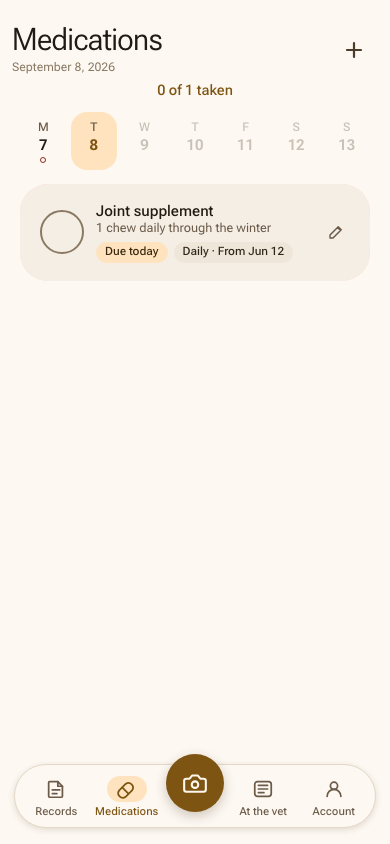
💊 The evening dose, before anyone has given it: the empty circle is the answer to "did you give her the tablet?"
Why this happens to careful people
Giving a pet a tablet takes four seconds. Remembering that you did it has to last twelve hours, through a workday, across two brains that were never in the same room when it happened.
Three moments break it, reliably:
The shift change
One person does mornings, one does evenings — until someone leaves early, or gets home late, and the dose lands in the gap between two people who each assumed the other had it.
The weekend
The routine that holds Monday to Friday is built on your routine, not the dog's. Saturday has no 7:40am alarm attached to it, and a dose that lives inside a commute disappears when the commute does.
The multi-drug course
One tablet is a fact you might remember. Three medications on different schedules — one with food, one twice daily, one for the next four days only — is an inventory, and nobody holds an inventory in their head accurately for a fortnight.
Add a second adult to any of these and the question changes from "did I?" to "did either of us?" — which is twice as hard and only half as answerable.
What to do if you think she's already had it
First, the practical part, because some people arrive here mid-panic.
Call your vet
Not tomorrow — now, or the out-of-hours line if it's late. A double dose is sometimes nothing and sometimes matters a great deal, and the difference depends on the drug, the size of your animal and what else she's on. That's a judgement for the person who wrote the prescription, not for a forum thread. If you cannot reach your own clinic, an animal poison line such as the ASPCA Animal Poison Control Center or the Pet Poison Helpline takes calls around the clock.
Don't try to fix it yourself. Don't induce vomiting unless a vet has specifically told you to. Don't skip the next dose to "balance it out" without asking — with some medications that does more harm than the extra tablet did.
What to watch for in the next few hours, while you wait for the call back: vomiting or diarrhoea, unusual sleepiness or restlessness, wobbling or a drunken walk, drooling, a racing or very slow heartbeat, trembling, or refusing food and water. With most everyday medications a single extra dose passes without any of these — but if one appears, say so on the phone, because it changes the advice.
Have these four things ready when you call:
The drug
The exact name and strength, as printed on the sheet or the box.
How much
In mg or ml — not "one of the white ones".
When
Each dose, as precisely as you can.
What else
Everything she's currently taking.
Here's the uncomfortable thing about that list: it's the same list you can't produce, for the same reason you're calling. The bottle's label is half rubbed off, the sheet is in a drawer, and the person who gave the morning dose is asleep.
Keep watch, and if anything changes — vomiting, wobbliness, unusual drowsiness, anything that isn't her — go in rather than wait it out.
The workarounds, and where each one gives up
Most households invent a system after the first scare. They mostly half-work.
The whiteboard on the fridge
Honestly good, and better than nothing. It fails the moment one of you isn't standing in the kitchen — at work, at the clinic, at your mum's with the dog in the car.
The pill organizer
Works for humans because humans take the same thing every day for years. Works poorly for a 7-day course of two drugs at three different times, and tells you nothing about when the empty compartment was emptied.
The shared note
Closer. But it needs both people to remember to open an app they don't otherwise open, and it degrades into a wall of timestamps that nobody reads by day four.
Phone alarms
They tell you a dose is due. They cannot tell you it was given, which is the actual question. An alarm you dismissed while driving is indistinguishable from one you acted on.
"We'll just remember"
This is the system most people are actually running, and it is the one that produced the conversation at the top of this article.
The common failure in all of them: the record and the second person are never in the same place at the same time.
One record, two phones
So put the record where both people already look — their own phones — and make a dose ticked by one of you visible to the other.
That's what sharing a pet in HeyVetto does. Send the other person in the house a code and you both hold the same animal: the same documents, the same doses, the same history.
A dose ticked on one phone shows as taken on the other. The evening person can see, from the sofa, that the morning one already happened.
Both of you can add, edit and delete — not one owner and one spectator. The person at the clinic can file the new sheet themselves, whichever of you it is.
One invite code, read out loud or sent as a link. It works once, and for 48 hours.
Stop sharing whenever you like. Everything stays in your account.
💊 One tick, at the moment the tablet goes in. The other phone shows it as given, so nobody asks.
And because the prescription was read off the vet's own sheet rather than typed in from memory, the course already knows the name, the dose, the frequency and how many days are left. Your phone says what's due today; the ticks say what's done.
One honest caveat: this only works if you tick it when you give it, not "later." A shared record fixes the communication problem — two people, one truth — and no app can fix a dose that went unlogged. The good news is that ticking takes one second at the exact moment you're already holding the animal, which is the easiest habit in this whole article to keep.
The other thing it fixes: "her papers are on my phone and I'm at work"
The camera-roll approach to pet records has a design flaw that shows up the first time it's tested: the person standing at the clinic is almost never the person with the photos.
Your partner takes the cat in for the limp. The vet asks what she's on and whether she's ever reacted to anything. Every relevant document is sitting in a photo album on a phone in a different building, and you're now conducting veterinary medicine by text message, badly, while in a meeting.
A shared record ends that. Whoever is holding the lead is holding the file — the vaccination dates, the current medications, the allergies, the chip number, the lab values in a row (and what the abbreviations on a lab sheet mean). One tap copies the whole summary as text, into a message or onto the receptionist's screen.
It's the same fix for a pet sitter, a boarding kennel, an adult child who takes the dog for a fortnight, or a locum who's never met your animal — and the same reason the history belongs in one place rather than five.
Setting it up takes about two minutes
Photograph the prescription sheet you were handed at the last appointment. The drug, the dose and the schedule come back as text you can search, with the original photo kept underneath. (The old folder can wait — see how to organize pet records for what to do with it later.)
Send the invite code to the other person in the house. One code, once, good for 48 hours.
Tick the next dose you give. That's the habit. Everything else is already done.
No account needed to start, and it works offline — including in a waiting room with concrete walls and no signal. It's free while HeyVetto is in testing.
❓ Questions owners ask
I gave my dog a double dose of her medication. Is she going to be okay?
Usually yes, often it depends, and nobody on the internet can tell you which — call your vet or the out-of-hours line with the drug name, the strength, the amount and the timing to hand. Watch her in the meantime, and go in if anything changes.
Is it worse to skip a dose or to give an extra one?
That depends entirely on the drug, and your vet is the one to ask. What you shouldn't do is guess in either direction — which is precisely the position a shared record keeps you out of.
Can two people use one pet record?
Yes. Send an invite code and you both get full access — adding, editing and deleting — not a read-only view for one of you. Sharing can be stopped at any point, and the records stay in your account.
Does the other person need to pay, or make an account first?
No. HeyVetto is free while it's in testing, and the code is all they need to join the pet.
What if we split up, or the sitter's fortnight ends?
Stop sharing. The record is still yours, and you can export everything as PDF whenever you like.
Does a dose ticked on one phone really show on the other?
Yes — that's the point of it. Tick once, and the other phone shows it as taken, so nobody gives it twice.
Is one extra dose dangerous?
Usually not, and sometimes very. With most everyday medications — antibiotics, joint supplements, many anti-inflammatories at the usual dose — a single extra tablet passes with an upset stomach at worst. With a few, such as heart medications, some painkillers, thyroid tablets and anything dosed to the kilogram in a small animal, two doses can matter within hours. The drug name on the box decides which group you are in, and the person to ask is the vet who prescribed it, or an animal poison line — not a search result.
The tablet is in your hand and you don't know. That's not a memory problem — it's a two-people-one-animal problem, and memory was never going to be the fix. Put the course somewhere you can both see it, and the eight o'clock conversation stops happening.
Do the current prescription tonight, send the code across the room, and tick the next dose you give. Free while we're in testing — no account to start, works offline, never sold.