One folder per pet, a one-page summary in the front, sections for vaccinations, visits, lab results and medications with the newest sheet on top — and a photograph of every sheet on the day you are handed it. The details are below.
Most people already have the records. They are in a drawer, in a glovebox, in a photo somewhere on the phone, and in the emails of two clinics. Organizing them is not about buying a binder. It is about being able to answer, at a counter, with a sick animal on the table, what she had and when.
📌 Read this first
The method here is the one clinics and insurers describe when they are asked what owners should keep, and it is deliberately boring: it has to survive fifteen years, two house moves and a change of vet. The only rule that matters is the last one — photograph each sheet on the day. Every other rule can be caught up on a rainy evening. That one cannot.
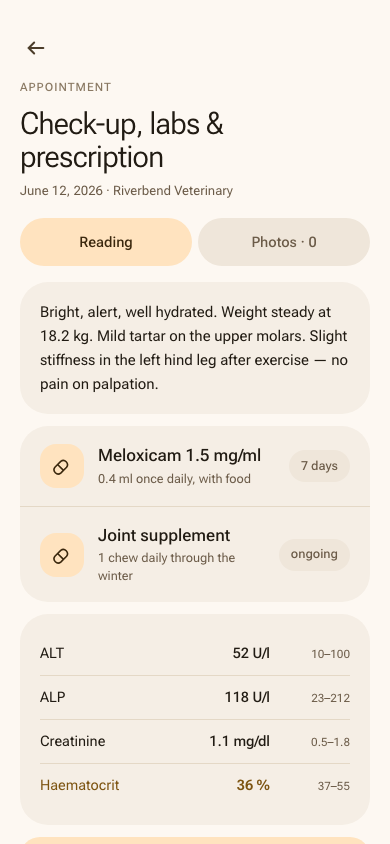
🗂️ One visit, filed: the note, the two prescriptions and the lab values, each read off the photograph of the sheet.
What belongs in a pet's medical record?
Everything a vet who has never met your pet would want before touching her. That is a longer list than the vaccination card, and the vaccination card is the only part most owners keep.
Identity
Name, species, breed, sex, date of birth, colour, whether neutered — and the microchip number, which is the only one of those a border official trusts. Adoption or purchase papers, and the pedigree if there is one.
Vaccinations
Every entry with the product, batch sticker, date given, date due and the vet's stamp. Rabies on its own line: it is the one that gets checked. See what a vaccination certificate must contain.
Visit notes
What was found, what was decided, and what to come back for. Clinics keep these; owners rarely ask for them. They are the part of the history that disappears when you change vet.
Lab results
Blood, urine, and any imaging report, with the date and the reference ranges printed beside each value. A single result is a number; the same result next to last year's is a trend. See what the abbreviations mean.
Medications
Name, strength, dose, how often, start and end dates — and for anything ongoing, whether today's dose has been given. Include parasite treatments, which never get a card and are the dates most often lost.
Surgeries and anaesthetics
Date, procedure, and anything that went wrong. Every future anaesthetic is planned against this.
Allergies and conditions
Drug reactions, food intolerances, chronic diagnoses. Short, and at the front.
Insurance and receipts
Policy number, insurer's phone number, and invoices until each claim is settled.
How do I set up the folder?
One folder per pet, not one per topic. A vet asks about the animal, not about dentistry, and a folder that has to be searched across three binders is a folder that stays at home.
Label the cover with the pet's name and microchip number. The number is what every form asks for and what nobody remembers.
Put a one-page summary at the front — see the next section. This is the page a new vet actually reads.
Four sections behind it: vaccinations, visits and surgeries, lab results, medications. Tabs or coloured sheets; anything you can flip to with one hand.
Newest on top in every section. The question at the counter is nearly always "when was the last one".
Photograph each sheet before it goes in. The folder lives at home. The phone comes to the clinic.
Keep the folder where the lead is kept, not in the study. The moment you need it is the moment you are leaving the house in a hurry. And keep one printed copy of the summary page in the car: phones run out of battery, and the emergency clinic at 2 am does not care why.
🗂️ One folder per pet. The summary in front is the page a new vet reads; the four sections behind it are where the sheets go, newest on top.
What goes on the one-page summary?
The first page is the whole record at a glance, and it is the only page most vets will read before the appointment. It should fit on one side and be rewritten, not annotated, whenever something changes.
Line
What to write
Why a vet wants it first
Who
Name, species, breed, sex, neutered, date of birth, microchip number, weight and the date it was taken
Doses are calculated from weight. An old weight is a wrong dose
Conditions
Chronic diagnoses, in the vet's words, with the year
Changes what is safe to give and what is worth testing
Allergies and reactions
Drug, food, vaccine — and what happened
The one line that prevents a repeat emergency
Current medications
Name, strength, dose, how often, since when
Every new prescription is checked against these
Last vaccinations
Rabies and core: date given, date due
Boarding, grooming and travel all start here
Last lab work
Date, and the two or three values being watched
Tells the vet whether to test again or compare
Contacts
Regular clinic, emergency clinic, insurer and policy number, second owner's phone
The number a pet-sitter needs at 11 pm
Paper, a cloud folder, or an app?
All three work, and most people end up with two of them. The question is which one is with you at the counter and which one can answer a question rather than show you a picture of the answer.
Paper folder
Never runs out of battery, accepted everywhere, and the certificates with stamps on them have to live somewhere. Weakness: it is at home, and it cannot be searched. Keep it as the archive, not the working copy.
Photos and a cloud folder
Google Drive, iCloud, Dropbox — one folder per pet, one photo per sheet, named by date. With you everywhere and shared with the other person in the house in one tap. Weakness: a photo of a lab sheet is a picture, not a record — you still scroll through forty images to find the creatinine from last spring, and nothing reminds you a dose is due.
A pet health records app
Built to hold exactly this: vaccinations with due dates, medications with reminders, lab values you can put next to each other. The better ones read the sheet off the photograph so you do not type it in, keep the photo beside the reading, and share the record with the second owner or with a vet — that is what HeyVetto does, and what it was built for. Weakness: an app that closes takes the record with it, so pick one that exports everything as a file you can keep.
A workable set-up for most households: the paper folder at home as the archive, and an app on the phone as the working copy — with each new sheet photographed into the app on the day and filed in the folder that evening.
How do I get records from my vet?
Ask. The clinic owns the physical record and you have the right to a copy of it; in most places a clinic must provide one, or send it directly to a new vet, when the owner asks, and may charge a small fee for printing. Ask for the whole record — visit notes, lab results, imaging reports — not only the vaccination card, and ask for it by email as a PDF, which is easier to file than a stapled print-out. If the pet has seen more than one clinic, that is one request per clinic; a clinic only holds what it saw. When you move, do this before you leave, while you are still a customer.
What does a new vet actually ask for?
Not the folder. A handful of dates and numbers, in the first two minutes, while the animal is being weighed. When was her last rabies. Is she on anything, and did she have it today. What were her kidney values last time. Has she ever reacted to anything. Can we have a copy of her file. An owner who can answer those five from a phone has an organized record; an owner with a beautiful binder at home does not, at that moment. That is the whole test, and it is the one to organize for.
❓ Questions owners ask
Who owns my pet's medical records?
The clinic owns the physical record — the file, the notes, the images. You have the right to a copy of it, and in most countries a clinic must give you one, or send it to another vet, when you ask; a small fee for printing is normal. Ask for the full record, not just the vaccination card. The visit notes and lab results are the part that gets lost between clinics.
How long should I keep pet medical records?
For the life of the pet, and a year or two after. Vaccination and rabies certificates are asked for at every kennel and border. Lab results only become useful next to the previous ones, so the old ones are what make the new one readable. Surgery and anaesthetic notes are read before every anaesthetic to come. Receipts can go once the insurance claim they belong to is settled.
What if I have lost everything?
Start with the clinic: it keeps its own record and can print or email every visit it saw, usually for a small fee. If the pet has seen more than one clinic, that is one call per clinic. The microchip register only holds your contact details, not the medical history, and the insurer holds claims, not results. From today, photograph each new sheet on the day it is handed to you — the record rebuilds itself faster than you expect.
Which records do I need to travel with a pet?
A rabies vaccination certificate that carries the microchip number, given at least 21 days before travel in and around the EU, and a pet passport or an animal health certificate issued by a vet shortly before the trip. Some destinations also require a tapeworm treatment, recorded by a vet 1 to 5 days before entry. The rules differ by country and change without much notice — check the destination's official page, not a forum, and check it again the week before.
HeyVetto reads the dose, the date and the lab values off the photo, keeps the photo beside them, reminds you before the next dose, and shares the record with the other person in the house. Free while we're in testing.