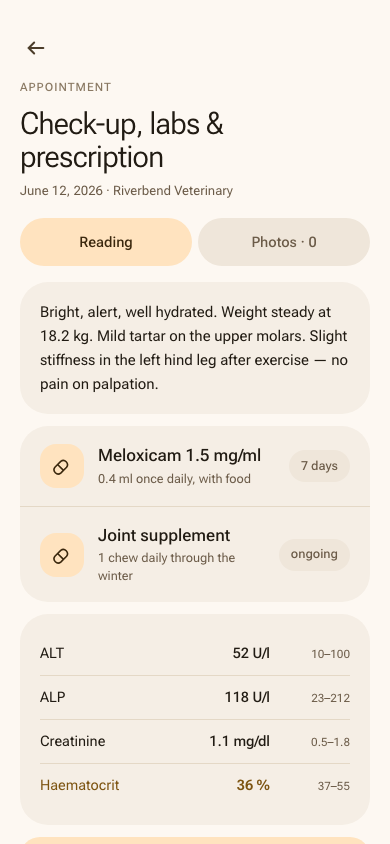
A vet lab sheet is a printout of blood and urine measurements, each shown as an abbreviation (ALT, ALP, HCT, USG), a number, and the reference range for a healthy dog or cat. This glossary explains what each abbreviation measures.
You are handed a page of three-letter codes and numbers, and the appointment is over. This is what each of those codes is measuring, in the words a person would use. It covers the blood and urine panels a dog or cat gets most often.
📌 Read this first
This is a glossary, not a diagnosis. A value outside the range is a question for your vet, not an answer — plenty of them move with age, breed, a recent meal, a stressful car ride, or the machine that ran the sample. The normal range that matters is the one printed on your own sheet, beside your own number, by the lab that ran it.
🩸 The same four lines from a lab sheet, read off the photo: the value, the unit and the range it is judged against.
What do the blood chemistry values measure?
ALT
An enzyme that lives inside liver cells. It appears in blood when those cells are damaged, so it is the first liver number most vets look at.
AST
An enzyme found in liver and muscle. Read next to ALT, it helps say whether a result is coming from the liver or from somewhere else.
ALP, ALKP
Alkaline phosphatase — liver, bile ducts and growing bone. Normally high in a puppy or kitten, because the bone is still growing.
GGT
An enzyme of the bile ducts. Read together with ALP to separate a bile problem from a bone one.
TBIL, bilirubin
The pigment left when red blood cells are broken down. It is the substance that turns gums and eyes yellow.
BUN, urea
A waste product of protein that the kidneys clear. It also moves with dehydration and with a high-protein meal, so it is never read alone.
CREA, creatinine
Waste from muscle that the kidneys clear. The classic kidney number — and one that only shifts once a fair share of kidney function is already gone, which is why the trend matters more than one reading.
SDMA
A newer kidney marker that tends to move earlier than creatinine does.
GLU, glucose
Blood sugar. In cats a stressful trip to the clinic alone can lift it, which is why a vet may want a second measure.
TP, total protein
All the protein in blood at once — albumin and globulin added together.
ALB, albumin
A protein made by the liver. It holds fluid inside blood vessels, and it moves with the liver, the gut and the kidneys.
GLOB, globulin
The other protein group, which includes antibodies — so it speaks to inflammation and to the immune system.
Ca, calcium
A mineral read alongside phosphorus, with the kidneys, the parathyroid glands and bone in mind.
PHOS, phosphorus
The mineral calcium is read against. It also rises as kidney function falls.
Na, K, Cl
Sodium, potassium and chloride — the electrolytes. They speak to hydration, to the kidneys, to vomiting and diarrhoea, and to the adrenal glands.
CHOL, TRIG
Cholesterol and triglycerides — the fats in blood. In dogs they are also read as a thyroid clue.
AMYL, LIPA
Amylase and lipase, enzymes of the pancreas.
T4, fT4
Thyroid hormone. Low in dogs and high in cats are the two common directions.
Cortisol
An adrenal hormone, usually measured as part of a stimulation or suppression test rather than on its own.
What does the blood count measure?
RBC
How many red blood cells there are.
HGB, haemoglobin
The pigment inside red cells that actually carries the oxygen.
HCT, PCV
Haematocrit, or packed cell volume — the share of blood that is red cells. This is the anaemia number.
MCV, MCHC
The average size and colour of the red cells. They say what kind of anaemia, not whether there is one.
RETIC
Reticulocytes — young red cells. They say whether the bone marrow is answering the shortfall.
WBC
All the white blood cells together: the infection and inflammation number.
NEU, neutrophils
The white cells that arrive first at an infection.
LYM, lymphocytes
The white cells of longer-term immunity. Stress alone moves them.
MONO, monocytes
The white cells that clear up after inflammation.
EOS, eosinophils
The white cells of parasites and allergy.
BASO, basophils
The rarest white cells, counted for completeness.
PLT, platelets
The cells that make blood clot. Also the ones a machine miscounts most often, which is why a low result is often looked at again by eye.
What do the urine values measure?
USG
Specific gravity: how concentrated the urine is. A kidney result in blood means little without this beside it.
pH
How acid or alkaline the urine is — which speaks to infection and to the kind of crystals that can form.
UPC, protein
Protein leaking into urine, measured against creatinine so the concentration does not distort it.
Glucose, ketones
Sugar and its by-products in urine. Neither belongs there in a healthy animal.
Blood, RBC
Blood in the urine — from the bladder, the kidneys, stones, or simply the way the sample was taken.
Sediment, crystals
What is left when the sample is spun and looked at under a microscope: cells, crystals, bacteria.
🩸 The range beside the value is the lab's own. A result outside it is a question for the vet, not a diagnosis.
What are the normal ranges for a dog and a cat?
These are typical reference intervals of the kind a large commercial lab prints, in the units most sheets use. They are here so that a number on its own has something to stand beside. The range on your sheet, from the lab that ran your sample, is the one that counts — and it can differ from these by a fair margin.
Value
Unit
Dog
Cat
ALT
U/l
10–125
12–130
AST
U/l
0–50
0–48
ALP
U/l
23–212
14–111
GGT
U/l
0–11
0–4
TBIL
mg/dl
0–0.9
0–0.9
BUN
mg/dl
7–27
16–36
CREA
mg/dl
0.5–1.8
0.8–2.4
GLU
mg/dl
70–143
74–159
TP
g/dl
5.2–8.2
5.7–8.9
ALB
g/dl
2.3–4.0
2.2–4.0
Ca
mg/dl
7.9–12.0
7.8–11.3
PHOS
mg/dl
2.5–6.8
3.1–7.5
HCT
%
37–55
30–45
HGB
g/dl
12–18
8–15
WBC
×10⁹/l
6–17
5.5–19.5
PLT
×10⁹/l
200–500
300–800
USG
—
1.015–1.045
1.020–1.040
What does a high ALT mean — 150, 500, 1,000?
ALT is the number owners search for most, because it is the one most often flagged. It leaks out of liver cells when they are stressed or damaged, so the height says roughly how many cells were involved — not why.
Just over the line
Up to about twice the top of the range. Common, and often nothing: a recent meal, a medication (steroids, some seizure and pain drugs), a bout of vomiting, a muscle strain. The usual answer is to recheck in a few weeks.
Several times the range
Roughly 300–600 U/l in a dog. This is a real signal. The vet reads it next to ALP, GGT and bilirubin to work out whether it is the liver cells themselves or the bile system, and usually adds an ultrasound or a bile-acid test.
1,000 and above
Widespread, active damage — a toxin (xylitol, some mushrooms, certain plants), an infection, or an acute disease. This is a same-day conversation, not a recheck.
Two things move the reading more than the number itself: the trend, and the company it keeps. An ALT of 180 that was 60 last spring says more than a steady 200 — which is exactly why the old sheets are worth keeping where they can be read back.
How do you read the sheet itself?
Reference range
The band printed beside your value. It belongs to that lab and that machine, and it differs by species, by age and sometimes by breed. Two labs can call the same number normal and abnormal.
H, L, ★, bold
Flags meaning "outside the printed band". They mean look here — not "wrong".
Units
U/l, mmol/l, mg/dl, µmol/l. The same substance is printed in different units by different labs, so a number only compares to another number in the same units.
The trend
One value is a dot. Three of the same value across a year is a line, and the line is what tells you whether something is moving.
What does ALT measure on a dog or cat's blood test?
ALT is an enzyme that lives inside liver cells. It appears in blood when those cells are damaged, so it is the first liver number most vets look at. A value outside the range is a question for your vet, not an answer — plenty of values move with age, breed, a recent meal, a stressful car ride, or the machine that ran the sample.
What does USG measure on a urine test?
USG is specific gravity: how concentrated the urine is. A kidney result in blood means little without this beside it.
What does the reference range on a lab sheet mean?
The reference range is the band printed beside your value. It belongs to that lab and that machine, and it differs by species, by age and sometimes by breed. Two labs can call the same number normal and abnormal. Flags such as H, L, a star or bold mean "outside the printed band" — look here, not "wrong".
What is a normal ALT for a dog?
Most labs print roughly 10–125 U/l for a dog and 12–130 U/l for a cat, but the exact band belongs to the lab that ran the sample and is printed beside the value on your sheet. A result a little over the top of the range is common and often temporary; several times the range is worth a same-week conversation with your vet, read alongside ALP, GGT and bilirubin.
Take the sheet to the appointment, and take the last one too. "Is the creatinine still climbing?" is a better question than "is the creatinine high?", and it is the one your vet can answer in a sentence.
HeyVetto photographs a lab sheet and files the values as text, each one next to the range the lab printed — so next year's sheet has something to be compared against. Free while we're in testing.