
Medication
“Did you give her the tablet?” — “I thought you did.”
Two people, one pet, one prescription — and nobody's sure. What to do if you double-dosed, and how to set up a record both phones can see.
Written by HeyVetto · Updated
Your pet's history isn't missing, it's scattered. Photograph the next sheet you're handed, let the text be read off it, check three fields — and the record builds itself from there.
The vet looks up from the screen and asks when your dog last had her rabies shot.
You know this. You were there. It was spring, maybe the end of winter, and there was a sheet — the one with the stamp.
You start scrolling your camera roll with one hand, because the other one has a lead in it. Somewhere between a parking sign and 40 pictures of the same sleeping dog, there is a picture of that sheet. Probably.
The answer exists. It's just not here. Your pet's medical history is spread across five places, none of which talk to each other, and four of which are useless at the exact moment you need them.
| Where it lives | Complete? | With you? | Searchable? |
|---|---|---|---|
| The clinic's system | Yes | No | No |
| The drawer | Yes | No | No |
| The camera roll | Partly | Yes | No |
| The messenger thread | Scraps | Yes | Barely |
| Your memory | No | Yes | No |
| One record on your phone | Yes | Yes | Yes |
A photo album gives you an image of a page. To get an answer out of it, you are the search engine: scroll to roughly the right month, zoom in, squint at the handwriting, decide whether that's a 0.4 or a 0.9.
A record gives you the content. Drug name, dose, date, clinic, lab values — as text you can search, with the original photo kept underneath, because your vet will still want to see the sheet.
That's what HeyVetto does with a photograph. Edges snap themselves, three pages of results stay one record, and the findings, the prescription and the lab values come back as searchable lines. Handwriting included.
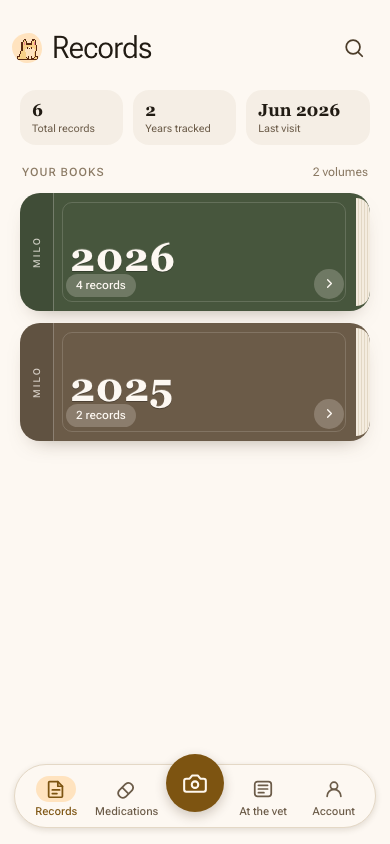
One search box, every sheet you've ever photographed, including the ones the vet wrote by hand.
One honest note: handwriting is hard, and HeyVetto sometimes gets a character wrong. It flags what it isn't sure about, and the original photograph is one tap away, unaltered. A tool that admits its doubt is more useful than one that sounds confident and is wrong.
Prescriptions are where well-meaning households go wrong. Not from carelessness — a 7-day course crosses a workday, a weekend, two people and one tired evening.
A broken course may not work. The FDA's guidance for pet owners is blunt: skipping doses, or not finishing, can mean starting over with a different drug.
So the prescription HeyVetto reads off the sheet becomes a course you tick off:
The last point matters more than it sounds. When a vet asks whether your cat has had antibiotics before, "I think so, the pink liquid one" is not an answer. A list with names and dates is. Same for lab values in a row: one reading is a number; next to last spring's, it's a trend.
"Did you give her the tablet?"
"I thought you did."
Nobody should solve that by memory. The honest answer is usually a shrug, then a skipped dose — or a double one. (If that is you, tonight, tablet in hand: what to do, and how to stop guessing.)
Send the other person in the house a code and you both hold the same pet: the same documents, the same doses.
This also fixes "her papers are on my phone and I'm at work" — the classic failure of the camera roll, where the person at the clinic is never the person with the photos.
A vet who has never met your dog starts from zero. There are six things they ask in the first two minutes, every time — and none of them are in your head in the right order.
HeyVetto assembles that page from documents you've already photographed. You never type a line of it:
The same page works for a boarding kennel, a new city, a sitter, or a locum at 9pm on a Sunday.
Most people never get organized because "digitize the folder" sounds like a Saturday. It isn't — you don't start with the folder at all.
No account needed to start. It works offline — the state your phone is usually in inside a concrete-walled waiting room. And it's free while HeyVetto is in testing.
Somewhere searchable, on your phone, open to everyone who cares for the animal — and backed by the original documents. Paper folders are complete but immobile; camera rolls are mobile but unsearchable. An app is both, provided it stores the content of the sheets, not just pictures of them.
The photograph is one tap away, exactly as the vet wrote it. HeyVetto flags readings it isn't sure of, and the original is never altered or deleted. If the sheet itself is the puzzle: what the abbreviations on a lab sheet mean.
No. Start with the next document you're handed. Old records go in whenever you feel like it — a few at a time, or never.
Backups are encrypted. Nothing is sold or shared with insurers. Sign out and the phone keeps nothing. Download everything — records and photos — as one file and leave whenever you want.
Yes. Dogs and cats, and multiple pets per account.
Export everything as PDF whenever you like. Leaving is easy on purpose — the only honest way to ask someone to keep their pet's history with you.
Ask the clinic, by phone or email, for the full record as a PDF — visit notes, lab results and imaging reports, not just the vaccination card. The clinic owns the file; you have the right to a copy, and in most countries it must provide one. A small printing fee is normal. The records guide has the whole process.
Sources: FDA — Medications for your pet: questions for your vet · AVMA — Your pet's medications
Five places. Every one holds a piece of the answer, and not one hands it to you at the counter with a dog on the lead. You don't need to organize the folder. You need to stop opening it.
Two people, one pet, one prescription — and nobody's sure. What to do if you double-dosed, and how to set up a record both phones can see.
One folder per pet, a one-page summary in front, a photo of every sheet on the day. What to keep, how to get copies from your vet, and what a new vet actually asks for.

Free while we're in testing. Do one document tonight and see what it makes of it. Otherwise the answer stays in a drawer at home, and the next time a vet asks what she's already had, you'll guess. iPhone & Android · no account to start · works offline · never sold.
Get HeyVetto free